
Skip to content
World Theatre Training Institute AKT-ZENT/ITI

DE
EN
  • ABOUT
    • WTTI IN BRIEF
    • STORY
    • IMPRESSIONS
    • ARTISTIC DIRECTOR
    • PROGRAMME DIRECTOR
    • TEAM OF TEACHERS
    • SPACES
  • PROGRAMMES
    • OPEN CALLS FOR ARTISTS
    • OFFERS FOR LEARNING INSTITUTIONS
      • TRAINING AS METHOD
      • ALTERNATIVE COURSES
      • MANAGEMENT AS ART – THE ARTIST AS MANAGER
    • INTERNATIONAL THEATRE SUMMER ACADEMY
    • ALthattheatre – EXERCISE 40/40
      • MY THEATRE EDUCATION
      • POSTGRADUATE PERSPECTIVE
      • Impulse Seminars
      • Online Training
      • The 40 Days
      • Practical Information
    • INTERNATIONAL DIRECTORS‘ AND TRAINERS‘ COLLOQUIUM
    • TEACHING PROFESSIONAL THEATRE PRACTICE
    • METHODIKA
      • IX METHODIKA 2021
    • WORLD THEATRE TRAINING LIBRARY
  • ONLINE THEATRE ACADEMY
  • IDEA CENTRE
    • VIDEO LECTURES
    • TEXTS
    • THE TEACHERS‘ VOICES
  • NETWORK
    • ITI WORLDWIDE
      • World Theatre Day 2021
    • ITI/UNESCO Network for Higher Education in the Performing Arts
      • Online Conference
    • EUROPEAN ASSOCIATION FOR THEATRE CULTURE
    • ISTITUTO ITALIANO di PEDAGOGIA TEATRALE
    • ALUMNI
  • BOOKSHOP
  • CONTACT
    • CONTACT FORM
    • APPLICATION FORM
    • NEWSLETTER

School of Directing – Start of a new course of studies

read in browser 

The World Theatre Training Institute announces

the new start of the international course of studies for Directing.

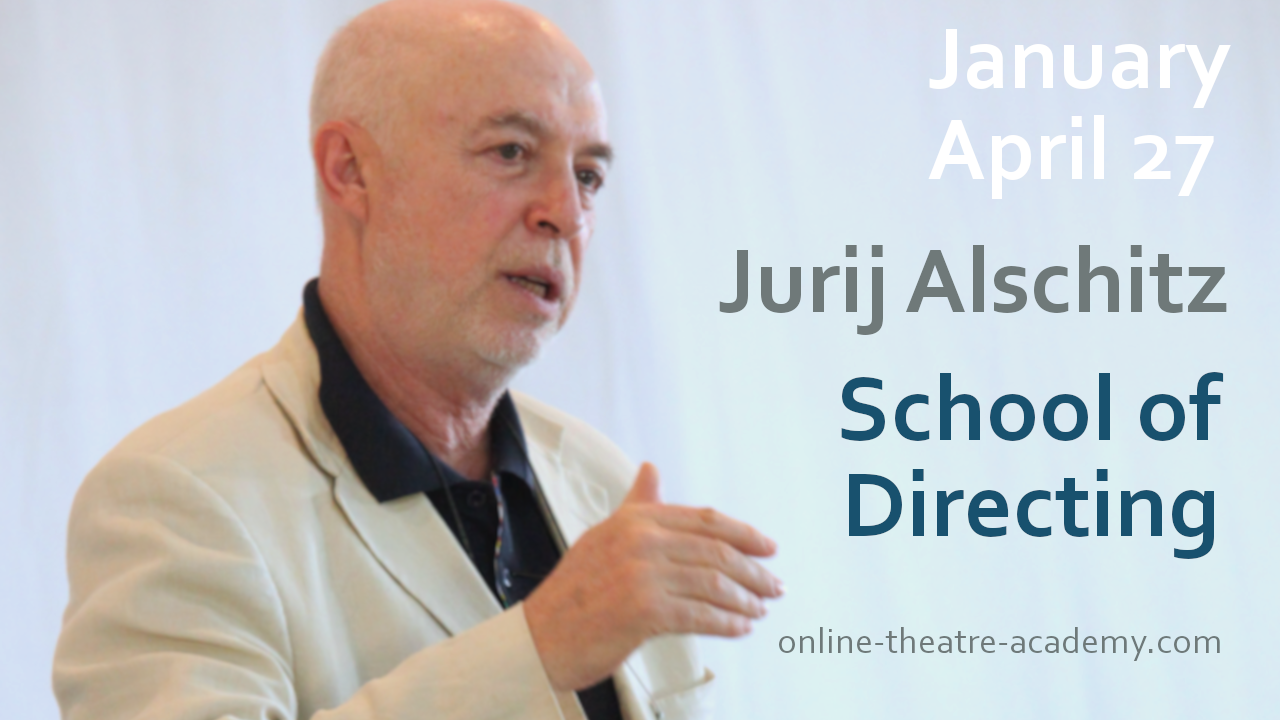
Dr Jurij Alschitz proposes

Three steps to professional directing

The Director
Prepares

08 – 10 January +
15 – 17 January 

The Director’s
Tools

05 – 07 February +
12 – 14 February 

Rehearsal
Methods

09 – 11 April +
16 – 18 April 

for emerging and experienced Directors,
Drama Teachers, Theatre Pedagogues,

for Actors with new professional perspectives

This unique online training programme is designed for those who have decided to pursue a directing career, as well as for all directors, theatre educators, actors and playwrights with professional experience, who wish to enhance their practical skills. It is aimed at those who want to learn important secrets of the profession.

The School of Directing is a 4-month intensive programme in three stages, with three modules. It is designed to take part in all three modules. In between, you are given extensive assignments so that you can develop the expertise you have gained into your own methodology.
However, it is possible to attend and book the modules individually.

You will go through all the stages of creating a play: from the director’s independent work in preparing the image of the play, its idea, theme, style, —  to the work on the text of the play, the laws of stage analysis of the text, —  to the rules of selecting actors, —  and finally to the original rehearsal methods developed by Jurij Alschitz. You will be given all the basics of the art of directing, which you will then have to develop further on your own. This is a life’s work. In other words, the course gives you a solid starting point for your independent journey into directing.

The Three Steps

The Director Prepares

There are a thousand things to think about when you start a project, it’s easy to lose track of what’s really important. Besides all the practical things that you might have to arrange, it is above all the time in which your vision – the image of the performance – should crystallise. The clearer and more comprehensive your vision, the greater will be your ability to accept, guide and integrate all the ideas of your future collaborators. The more precisely we work in advance, the greater our freedom and flexibility will be during rehearsals with the actors.

But what does precise preparation mean? During the preparation phase of a director’s work, the most important tool is to ask ourselves the right questions. Self-preparation goes hand in hand with self-provocation, namely the activation of creative energy when we try to find the answers. The method of questioning works both for ourselves and later in the dialogue with the actors.

Jurij Alschitz holds an endless treasure trove of specific questions and tasks that are indispensable for the self-preparation of the director.

In this course, participants will learn to create their directorial vision, the overall image of the performance. They will think about the myth, the story they want to tell; they develop the so-called “spherical view” and train to verbalize their ideas. They will build up their professional toolkit: what questions do I really need to ask and answer during my preparation? What are the best working methods for myself? What tasks and questions will I ask the actors?

The Director’s Tools

This course is about the instruments of the director. Talent and imagination need to be realised with professional tools. That is why the director must undertake an in-depth text analysis, as the basis on which to work with actors.

Jurij Alschitz will pose many questions and tasks to the participants and open up the text as a source of energy. What does the composition of a scene, the play, the planned performance look like? Already we come across many compositions: composition of themes, of facts, of events, of atmospheres, of relationships and conflicts…. How do I build the network, the cosmos of events? How do I recognise and deal with open and hidden events? How do the lines of the events of the various characters intersect?

If we take a closer look at the text, we enter the world of words, which follow their own laws. How do the threads of individual words weave themselves across the whole play? How do I prepare the actors for the labyrinth of words? Or is it the pauses? What happens in the empty spaces? Perhaps they are the real carriers of meaning? Does the scenic life take place without words? Where does the meaning emerge without words?

We can look at the text, the play as a musical work – what about rhythm and melodic lines? In which genre do I want to move, how do I want to change and develop it? Which styles do I use and how are they reflected in the overall production?

The questions will multiply during this course – they are the ABC of the professional director, his tools. The individual mastery will be revealed in the finesse of their application.

Rehearsal Methods

The biggest challenge for the director is realising their ideas with the actors on stage. The actor is the most important, but also the most complex, the most unpredictable material that the director encounters and has to deal with in the process of working on a play.

Every director should master more than one method of rehearsal. What works well for one author or actor is a waste of time for another. Therefore, a director needs to have several methods in reserve for a good production, just as the actor needs to have several methods in reserve for his role creation. Each method requires time and practice to learn so that it can be used creatively in rehearsals.

Over decades of artistic practice, Jurij Alschitz has developed various directing methods that are based on classical practices on the one hand, while on the other he utilises scientific findings in a highly innovative way and transfers them to the stage. In this course, he introduces basic and completely unknown methods of working with actors and gives participants the opportunity to try them out in practice.

As fundament, students will learn the “Table-Stage-Table-Method”, a variant of the well-known method of K.S. Stanislavsky and Maria Knebel – the effective method of analysis through action.

They will be introduced to the “Method of Constellation”, a way of working in which the creativity of the actors is released through very sparse impulses and the material is opened up in all possible directions and allowed to fragment.

They will discover “storytelling” as a useful way for directors in developing scenes as well as a whole performance.

The “Big Bang-Method” will show a very promising way of working with actors based on the idea of the Big Bang theory, from which our civilisation, our galaxy and the whole universe emerged. Another name for this approach is “Method of Explosion” because we are specifically dealing with the accumulation and release of artistic energy.

Finally, students should understand how to work with the classical “Method of Improvisation”. Improvisation lives in the “fetters of freedom”, i.e. it benefits from the precise setting of tasks and from professional handling. The principles and elements of improvisation and free composition are in many ways present in the previous methods of work and therefore are so necessary to know.

The methods naturally overlap each other and in many ways complement each other. This is the lifelong journey of discovery that follows this course when you will recombine and personally develop the different ways of rehearsing with actors.

register

Please connect with us for any further questions or consultation.
We will arrange a telefone or zoom meeting.

Use the opportunity to listen about the first subject
The Director Prepares
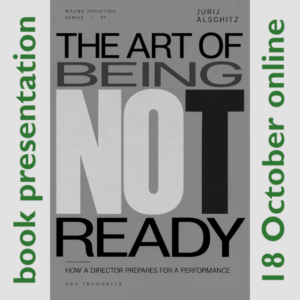
free lecture and book presentation with Dr Jurij Alschitz

on

18 October 15:00 – 16:00 (UTC+2) online

The Art of Being not Ready 

Register to get the link

Dear colleagues, dear friends. I have written a book about how a director can be unprepared. The book is called ‘The Art of Being not Ready’ and marks the start of my new series of publications, WRONG DIRECTING.

You must admit, for someone who has spent many years teaching others, this is rather suspicious. I have always taught people to prepare thoroughly: to read, think, analyse, and find a theme, an idea, and answers. But then I noticed something rather unpleasant: the better a director has prepared, the less likely the production is to surprise them.

That’s why I’ve decided to write a book about how a director should prepare – and still not be ready. The book is written primarily for directors. But actors might find it useful to consider that you can also prepare for a role in such a way that you don’t prepare it in advance. And theatre teachers will find it interesting to think about how to prepare a lesson so that you don’t know in advance how it will end.

During the presentation, I shall try to explain why a director spends so many years studying, only to one day earn the right to say: ‘I don’t know.’

I can’t promise that by the end of the session we’ll know any more. But I do hope we’ll have more questions.

Do come along. Let’s be unprepared together.

__________________________________________________

World Theatre Training Institute AKT-ZENT
Research Centre of the International Theatre Institute

+49 30 612 87 274    |    akt-zent@berlin.de

World Theatre Training Institute AKT-ZENT / ITI

Post navigation

← Previous Post
Next Post  →
  • Imprint
  • Privacy Policy
  • Terms and Conditions Bookshop

Powered by WordPress .Theme: Frolic by Genex Themes